At DOBA University of Applied Sciences, we recognise the importance of connecting theoretical knowledge with practical experience. This is why we regularly involve practitioners in the pedagogical process and enable students to test their knowledge in realistic simulations. This approach supports the development of key competences such as strategic thinking, communication skills and the effective management of negotiation processes.
As part of the course Communication with Influential Publics and Lobbying, students carried out negotiation simulations on Monday, 22 June 2026, following a previously prepared strategy. In the previous week, they had developed negotiation strategies, including defining the concepts of ZOPA and BATNA, and then further upgraded them in teams by assigning roles and preparing scenarios for the simulation.
The students presented the simulations in an online environment, where each team demonstrated the use of their prepared strategies in practice through a ten-minute negotiation scenario. Other students were able to provide feedback in real time, while the online mentors, Tamara Šimunaci Boškin and Sandra Lapčić Kovačić, excellently connected and guided the event.

The team of lecturers and online mentors during the simulations
A particular added value of the event was the panel of professors, who are also recognised practitioners:
After each simulation, the expert panel provided students with professional feedback, offering deeper insight into the quality of the negotiations carried out and additional guidance for the further development of their competences.
The simulations covered a wide range of current social topics – from housing and environmental policies to digitalisation, artificial intelligence and the future of work – enabling students to understand the complexity of contemporary negotiation processes.
In the negotiation simulations, students addressed current social, economic, environmental, technological and regulatory challenges:
1. Housing and tourism policy
2. Public events and space
3. Environment and spatial planning
4. The future of work
5. Digitalisation and artificial intelligence
6. Healthcare and labour legislation
7. Education policies
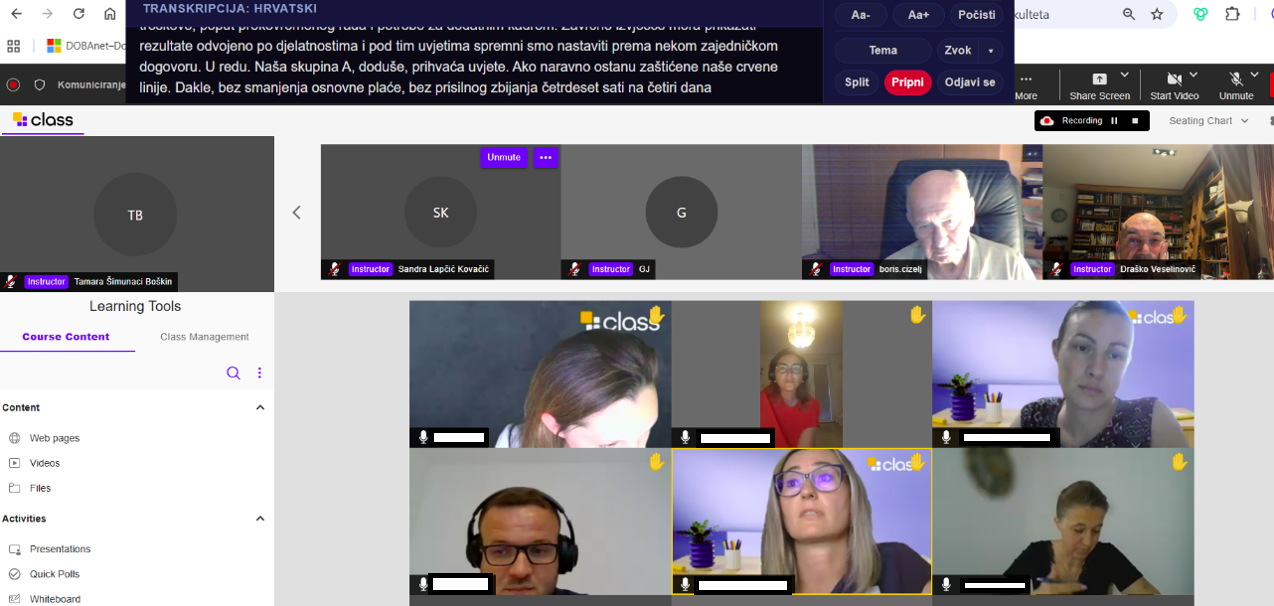
A glimpse of the negotiations, where Croatian students were provided with simultaneous interpretation into Croatian and vice versa
(the simulations involved both Slovenian and Croatian students, with cases from Slovenia and Croatia)
At DOBA University of Applied Sciences, activities like these enable students to ensure that knowledge does not remain only at a theoretical level, but is actively tested in simulated situations that closely resemble real-life circumstances, including in an international environment. In this way, they develop skills that are essential for successful work in today’s business and public environment.
